Best Python Books for Beginners (2026): Five Honest Options Compared
Five books account for nearly every “which Python book should I buy?” answer on the internet. This page compares them on the numbers that matter — price, pages, projects and pace — and says plainly where each one beats the others, including where each one beats ours.
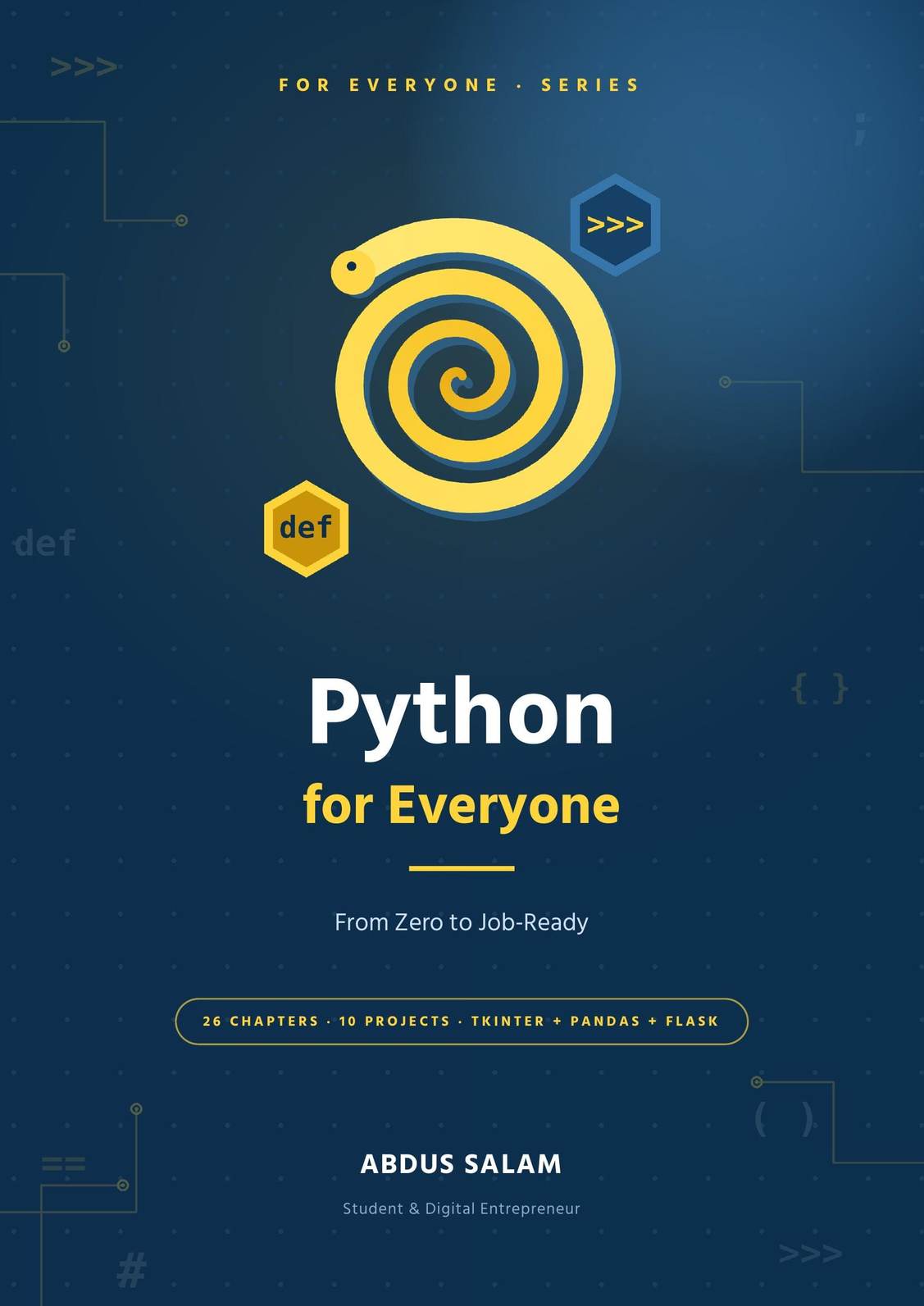
Disclosure first: this page is published by AheadKit, and one of the five books — Python for Everyone — is ours. That is exactly why the comparisons below stick to checkable facts (publisher list prices, page counts, project counts, what each book actually covers) and why each book gets the section it has earned, including the ones that beat ours. Prices were checked against publisher and retailer pages on 30 October 2026 and will drift; treat them as the shape of the market, not a quote.
The five, side by side
| Book | Price | Pages | Projects & practice | Best for |
|---|---|---|---|---|
| Python Crash Course, 3rd ed — Eric Matthes (No Starch, 2023) | $49.99 list (often $35–40) | 552 | Exercises throughout Part I; Part II is three substantial projects: a game, data visualisations, a web app | The beginner who wants the most proven, most complete single book and will finish it |
| Automate the Boring Stuff with Python, 3rd ed — Al Sweigart (No Starch, 2025) | $59.99 (2nd ed free to read online) | 672 | Practice questions per chapter; the tasks themselves are the projects — files, spreadsheets, PDFs, email, scraping | The office worker who wants Python to do real chores from week one |
| Head First Python, 3rd ed — Paul Barry (O’Reilly, 2023) | $65.99 list | 663 | Constant puzzles, exercises and code-alongs; builds toward a web app and data work with pandas | The visual learner who finds normal textbooks dry and falls asleep in chapter two |
| Python for Everybody — Charles Severance (2016, Creative Commons) | Free (print about $9.99) | ~247 | Exercises per chapter plus a free video course with autograded assignments on py4e.com | The self-learner on a zero budget, or anyone who learns best inside a course structure |
| Python for Everyone — AheadKit (PDF ebook) | $3.99 | 172 | Exercises per chapter and 10 step-by-step projects, incl. a Flask website and a pandas dashboard | The total beginner who wants short chapters, plain words and a gentle pace — for the price of a coffee |
One piece of context the table cannot show: in an analysis of 2,000 book recommendations gathered across 70 community lists, Python Crash Course was the most recommended beginner Python book (33.3% of lists), ahead of Head First Python (25.4%) and Automate the Boring Stuff (23.7%). That reputation is real, and it is the standard the rest of this page is measured against.
Python Crash Course — the benchmark, and priced like it
If you ask a room of programmers which Python book a beginner should buy, this is the answer you will hear most, and it has earned that. The first half teaches the language cleanly, and the second half is three real projects: a 2D game, data visualisation with real datasets, and a working web application. No other book on this page matches that project depth, and three editions of refinement show in the pacing.
Where it beats ours, plainly: depth, polish and track record. It is three times our book’s length, its projects are bigger, and a million-plus readers have tested it. Where it loses: price. At $49.99 list it costs more than twelve copies of our book, and for a reader who is not sure programming is for them, that is a serious amount to risk on a first step.
Automate the Boring Stuff — best when you have a job for Python
Al Sweigart’s book skips the “learn the language, then apply it” order. After the basics it goes straight at the work people actually want done: renaming hundreds of files, updating spreadsheets, pulling tables out of PDFs and web pages, sending email. The 3rd edition (2025) is the most current book on this page at 672 pages, and the whole 2nd edition remains free to read on the author’s website — a genuinely generous offer no paid book competes with.
Where it beats ours: practical automation coverage and that free online edition. Where it loses: readers who want the language taught slowly, in order, can find the task-led jump-around pace brisk; and at $59.99 the current edition is the most expensive print book here.
Head First Python — best for visual learners
Head First books teach through pictures, puzzles, conversations and deliberate repetition, and for readers who bounce off dense text it works where other books fail. At 663 pages it is the longest book here, and the 3rd edition carries you from the fundamentals to building a web app and working with data in pandas.
Where it beats ours: sheer teaching apparatus — if your brain learns visually, this format is built for you and ours is not. Where it loses: the same format is the complaint — some readers find it chaotic and slow to search when they return to look something up — and at $65.99 list it is the priciest option on the page.
Python for Everybody — the free one, and a real course
Charles Severance wrote this book for his University of Michigan course, and the course is the point: the book is free (Creative Commons), the videos are free, and the exercises on py4e.com are autograded, so the book tells you whether your answer is right. Its lens is data from early on — files, regular expressions, web services and databases.
Where it beats ours: it costs nothing and brings a full course with it; on price, free beats $3.99 every time. Where it loses: it reads like what it is — a university textbook from 2016. The tone is academic, the path is data-shaped rather than project-shaped, and readers who want to build things for their own sake sometimes stall in the middle chapters.
Python for Everyone — ours, and what it honestly is
Our book is the shortest and cheapest complete option here: 172 pages, 26 short chapters, $3.99 as a PDF. It was written for the reader the other books quietly leave behind — the absolute beginner for whom 552 pages is itself the obstacle. Chapters are short, the words are plain, every program was run and checked before the book shipped, and the 10 projects (among them a Flask website and a pandas data dashboard) are sized to be finished, not admired.
Where it beats the others: price per complete path through the language, and pace for a true beginner — nothing here assumes knowledge you do not have yet. Where it loses, and we will not dress this up: it is a new book from a small store. It has no decade of editions, no million readers, no university course behind it, and its projects are smaller than Crash Course’s. That is why the first three chapters are free to read online — the only honest way a book like this earns trust is by letting you read it before you pay.
Choosing, by reader
- Budget is no object and you will finish what you start: Python Crash Course.
- You have boring office work to kill: Automate the Boring Stuff — start with the free online 2nd edition and buy the 3rd if it clicks.
- Textbooks put you to sleep: Head First Python.
- Budget is zero, or you want a course with graded exercises: Python for Everybody at py4e.com.
- You want the gentlest complete path for the least money, and you want to read the start free before deciding: Python for Everyone — and if you later want the other languages too, the 11-book bundle at $12.99 is the maths that makes sense.
Whichever you pick, the rule that decides whether it works is not on this page: one book, finished, beats five books started. If you are still deciding how long the journey takes, our honest timeline guide puts numbers on it.
Questions people ask about this comparison
What is the single best Python book for a complete beginner in 2026?
If budget is not the question, Python Crash Course (3rd edition) is the safest answer — it is the most recommended beginner Python book there is, and its three projects are the deepest in this comparison. If budget is the question, Python for Everyone covers the same ground in shorter chapters for $3.99, and Python for Everybody is free.
Is Python Crash Course worth $49.99 when cheaper books exist?
For many readers, yes. You are paying for 552 pages, a decade of refinement across three editions, and a second half built around three substantial projects (a game, data visualisations and a web app). The cheaper books — ours included — are shorter and younger. The honest trade is depth and track record against price.
Which of these Python books is free?
Python for Everybody is free in full: the official PDF and a complete video course with autograded exercises are on py4e.com, under a Creative Commons licence. Automate the Boring Stuff (2nd edition) is also free to read online on the author’s website. Our own book’s first three chapters are free to read online, but the full book is paid.
I want to automate boring office work. Which book should I pick?
Automate the Boring Stuff with Python. It is built around exactly that: renaming files, working with Excel, Word and PDF documents, email and web scraping. The other four books teach the language first and automation later.
Are these books kept up to date?
Python Crash Course is on its 3rd edition (2023), Automate the Boring Stuff on its 3rd edition (2025), and Head First Python on its 3rd edition (2023) — all current Python 3. Python for Everybody dates from 2016 with materials updated online since. Python for Everyone is a current Python 3 book (it teaches Python 3.13).
Should I buy one book or a bundle?
One book, finished, beats five books started. Buy a bundle only when you already know you will go on to a second language — that is when the maths changes: our 11-book bundle costs $12.99, less than a third of one copy of Python Crash Course at list price.