How to Get Out of Debt: Avalanche vs Snowball, With a Worked Plan
There are two serious ways to pay off debt, and they disagree about one thing: whether to attack the highest interest rate first or the smallest balance. Here is the maths on the same example debts, and how to pick the method you will actually finish.
The two methods, in one paragraph each
Avalanche: pay the minimum on everything, then throw every spare dollar at the debt with the highest interest rate. When it dies, its payment rolls down to the next highest rate. This is the cheapest order in pure maths, because expensive debt dies first.
Snowball: pay the minimum on everything, then throw every spare dollar at the debt with the smallest balance, whatever its rate. When it dies, its payment rolls into the next smallest. This order costs a little more interest and buys something the maths ignores: an early win, and one fewer bill, fast.
Both methods agree on the part that matters most: minimums on everything, always, and one target debt that gets everything else you can find.
The same three debts, three ways
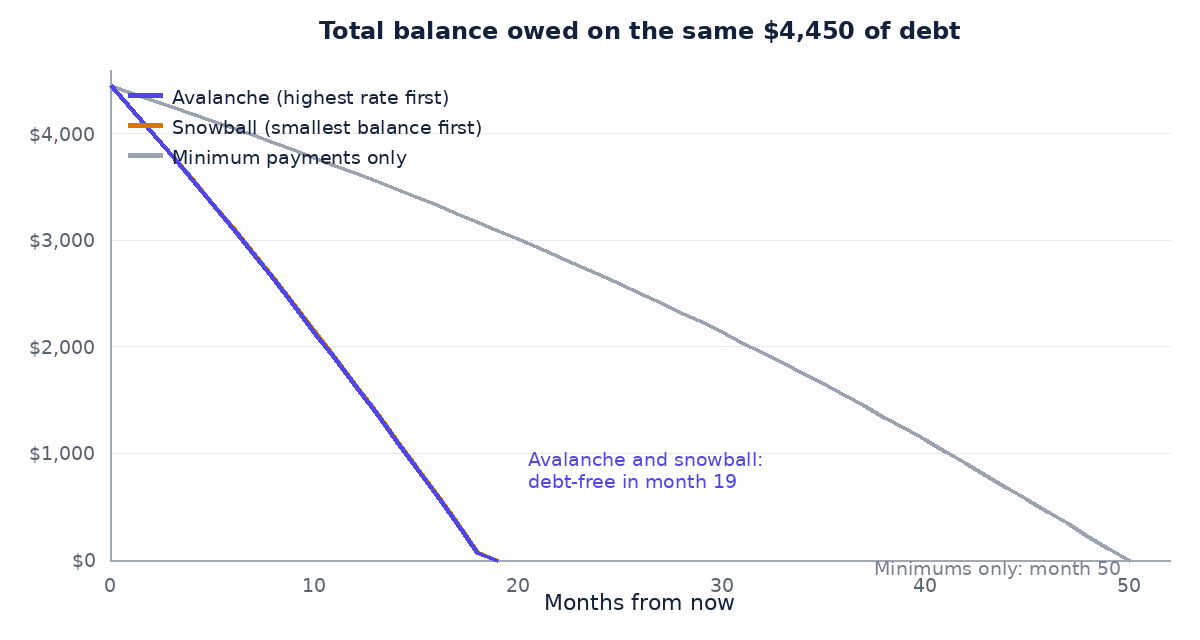
Take a realistic pile: a credit card with $1,200 at 24% APR and a $35 minimum, a store card with $450 at 19% and a $25 minimum, and a personal loan with $2,800 at 11% and a $60 minimum. Total owed: $4,450. Minimums add up to $120 a month. Assume the minimums stay flat and interest runs at the APR divided by twelve each month. Now run it three ways:
| Way of paying | Monthly total | Debt-free in | Interest paid |
|---|---|---|---|
| Minimums only | $120 | 50 months | $1,534 |
| Avalanche (Card A, then B, then C) | $270 | 19 months | $482 |
| Snowball (B, then A, then C) | $270 | 19 months | $494 |
What the numbers are really saying
The famous fight between the two methods turns out to be worth about $12 on debts of this size. Twelve dollars. The avalanche does win: it always wins on cost when the debts differ in rate. But look at where the first victory lands. Snowball kills the store card in month 3. Avalanche's first debt, the credit card, takes until month 8 to die. For five months, the snowball payer has one fewer bill and proof the plan works; the avalanche payer has a slightly better spreadsheet and nothing to show a sceptical partner yet.
Meanwhile the gap that actually matters is between both plans and minimums only: 31 months sooner, and roughly $1,050 kept instead of handed to lenders. That gap came from the extra $150 a month and from rolling dead debts' payments forward, not from the order. Pick the order you will still be following in month ten. A finished snowball beats an abandoned avalanche every time.
Build your plan in twenty minutes
- List every debt in one place: what you owe, the APR, and the minimum payment. No plan survives contact with a debt you forgot to write down.
- Set aside a small starter buffer first, $500 to $1,000 in a separate account, before attacking anything. Without it, the next broken phone goes straight back onto a card and the plan restarts.
- Pick your order. Highest rates first if the numbers motivate you. Smallest balances first if early wins do.
- Automate the minimums so a busy week can never cause a late fee, then automate the extra payment to your target debt for the day after payday, not the end of the month. Money left "for later in the month" has a way of being spent.
- When a debt dies, roll its whole payment into the next one the same month. This rolling payment is the engine of both methods; skipping it is how plans quietly slow to minimum speed.
- Re-run the list every three months. Rates change, balances change, and seeing the total fall on paper is fuel.
One honest boundary: this plan assumes you can meet the minimums. If you cannot, or debts are already with collectors, the right next step is a nonprofit credit counselor or your local debt-advice service, not a cleverer order of payments. There is no charge for that advice in most countries, and it comes with legal protections a spreadsheet cannot offer.