An ADHD Daily Routine That Survives a Bad Brain Day
Most routines fail ADHD brains by lunchtime on day two: too many timed slots, and guilt when one slips. This one asks for three things, puts the body before the to-do list, and assumes some days will collapse, then plans for that too.
Why timed schedules fail, and anchors work instead
The standard daily routine is a timetable: 7:00 wake, 7:30 exercise, 9:00 deep work. For an ADHD brain it has two fatal features. It treats time as something you can feel passing, which is the very thing ADHD makes unreliable. And it chains every block to the one before, so a late start at 7:40 quietly cancels the whole day by 9:15.
Anchors fix both problems. An anchor is a short sequence tied to an event, not a clock: after I get up, these three things. The day below is built from five anchors. They can happen at 6am or at noon; the order carries the routine, not the hour.
Anchor 1: body before willpower
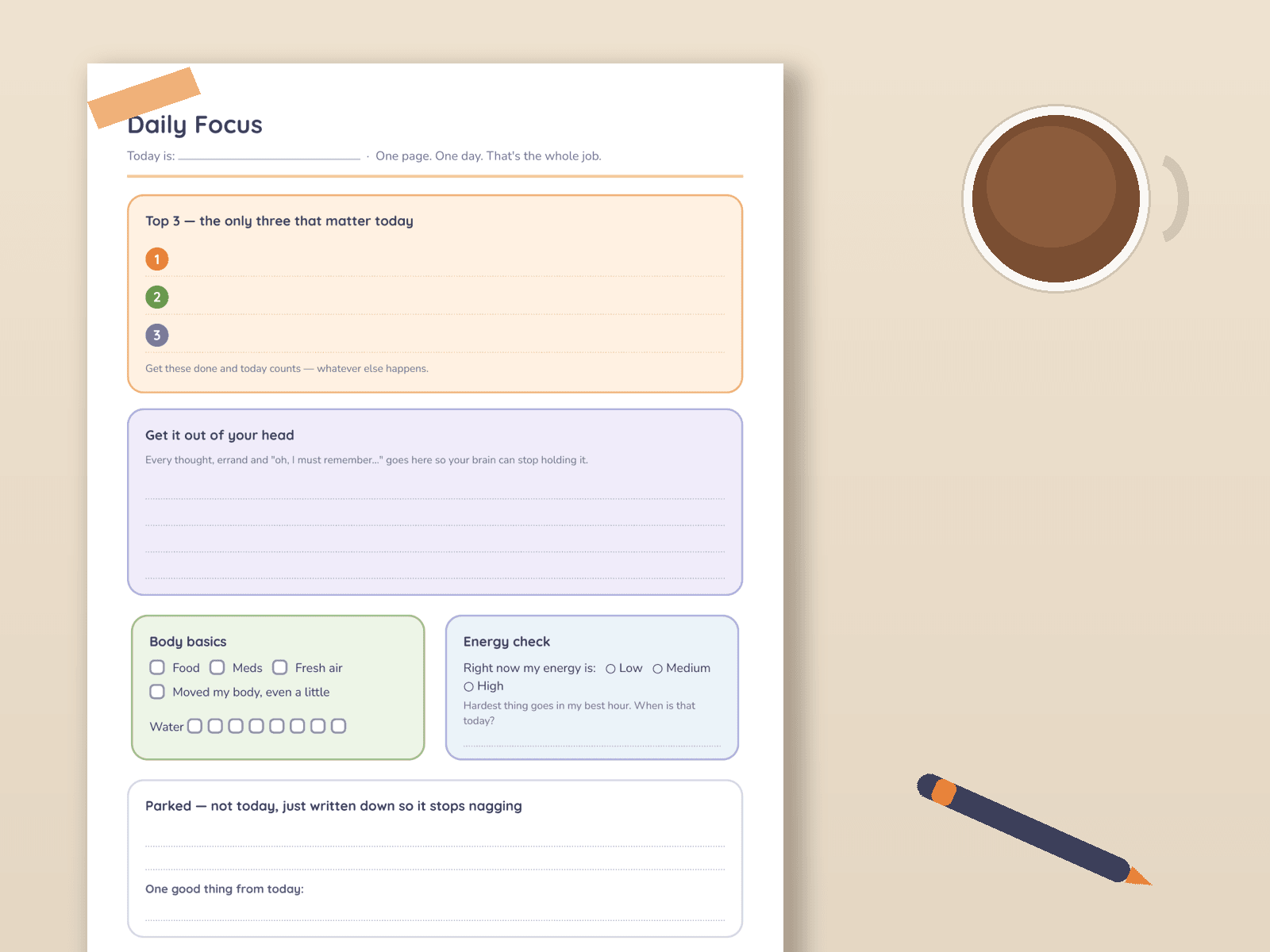
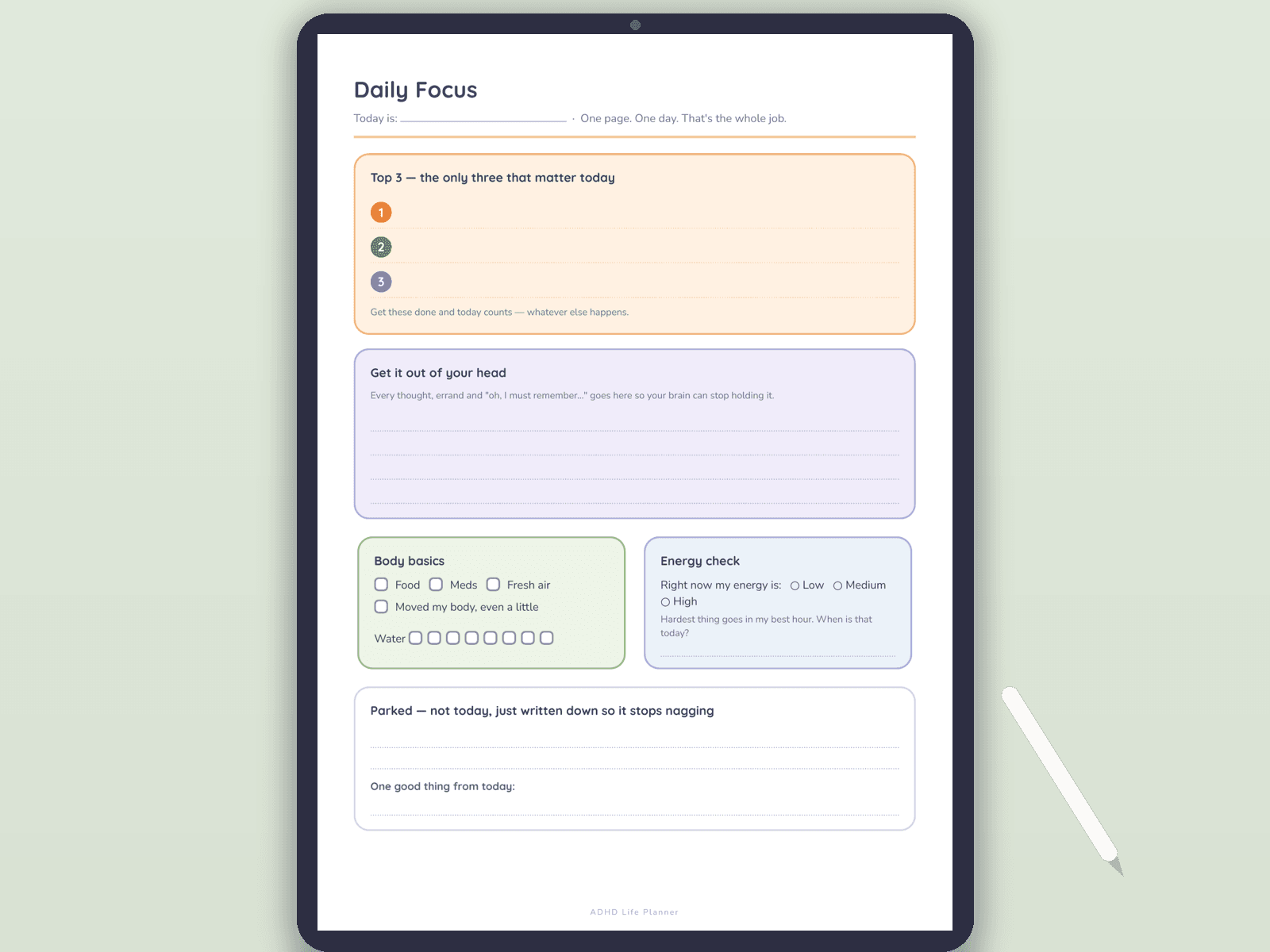
The first anchor is deliberately not about work. Water, something to eat, any medication you are prescribed, daylight or a short walk, in whatever order they happen. ADHD brains run on a noticeably shorter fuse when the basics are missing, and no planning system survives a brain that is dehydrated and unfed by 11am. Put the body basics on the page, physically tick them off, and count it as the first completed thing of the day, because it is.
Anchor 2: the Top 3, chosen from a brain dump
Before you choose anything, empty your head onto paper: every task, worry and half-idea currently circling. This brain dump is not a to-do list. It is a holding pen, and its job is to stop the circling. Then pick three. Not the three most urgent-feeling, but one that must happen today, one that moves something important forward, and one small quick win. Everything else goes on a parked list, which is a promise to your brain that nothing is lost, just not today.
Three is not a productivity hack; it is a load limit. A finished Top 3 on a rough day beats a fourteen-item list that ends in avoidance, and it leaves the evening feeling like evidence instead of failure.
Anchor 3: work in visible sprints, with a dopamine menu
Long open-ended work sessions are where the day goes to die. Work in sprints instead: a timer you can see, 15 to 25 minutes, one named task, phone in another room or face-down in a drawer. When the timer ends, take a real break from a dopamine menu, a list you wrote on a calm day of breaks that actually refresh you: music, a walk round the block, a snack, a stretch, a message to a friend. The menu matters because an unplanned break defaults to the phone, and the phone does not give you back.
Halfway through the day, do a ten-second energy check: high, flat or empty. Flat means the next sprint should be an easy task from the parked list. Empty means food, water and movement before any more deciding. Planning around your actual energy, instead of the energy the timetable assumed, is most of the game.
Anchor 4: the two-minute task breakdown
When a Top 3 item will not start, the item is almost always too big and too vague. "Sort the tax folder" cannot be started; "open the folder and take out the bank statements" can. Break the stuck task down on paper until the first step is embarrassingly small and physical, then do only that step. Starting is the hard part for ADHD brains; continuing, once started, is usually fine. Shrink the start.
Anchor 5: shutdown, and plan B for the collapsed day
End the workday with five minutes, not a review meeting with yourself. Tick what got done. Move what did not onto tomorrow's brain dump without commentary. Draft tomorrow's likely Top 3 so the morning starts warm. Then stop. Anything unfinished is scheduled, not failed.
And for the days it all collapses anyway, and there will be some, run plan B: body basics, one single thing from the Top 3, and the shutdown. That is a complete routine at minimum size. The mistake that ends most routines is treating a collapsed day as a broken streak that needs apologising for. An undated system has no streak to break. You turn the page, and the routine is simply there again tomorrow, which is the only feature that has ever made a routine stick.